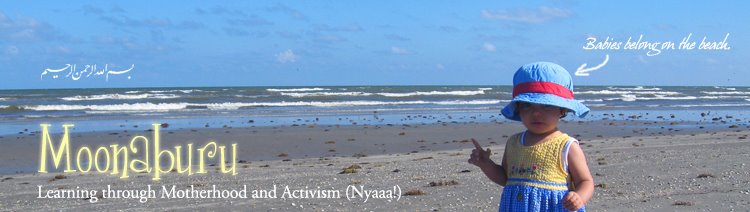
I moved. Oh yes I did.
I sat on this new title and design for two months to make sure it would weather time and changing moods and taste. No promises that this is the one, but for now and hopefully for a long time, I love it:
http://evensparrowspray.blogspot.com
All of the archives transferred, but unfortunately I lost the comments! :(
Sunday, August 16, 2009

Wednesday, June 10, 2009
Burrito Babies
I always swaddle my babies at night before sleeping. Very tightly. Until their eyes bulge out and they grunt from the pressure. It helps Baby Meem know that it's nighttime now and that she’d better not wake up until at least six hours have gone by. Supposedly it helps the baby feel cozy and secure, and prevents her from being startled by her own movements. I think it also works as some kind of cue if only used at nighttime. Even though she's an extremely light sleeper during the day, waking up if I so much as sneeze in the same room, when I swaddle her at bedtime, she sleeps long and sound alhamdulillah.
Moona and Buru love watching me swaddle the baby, and I show them how to do it with their dolls.
Yesterday as I was laying them down for their nap, Moona asks, "Can you wrap me like you wrap Baby Meem?"
And Buru seconds the request, “Mama, aa aa aa Ana Beebee?”
And so I wrap them one by one, rolling and kneading them as they giggle like they’re indulging in a guilty pleasure. Around their stomachs and onto their backs, one-two-three corners of the blanket come together until they are tightly wound up like a burrito. Arms bound to their sides, staring at the ceiling, they try very hard not to move so they don’t loosen Mama’s swaddle. It won't happen again tomorrow or the day after, so enjoy it while it lasts. I tried not to laugh at their looks of solemn reverence, as though swaddling children is the cleverest idea in the world.


Monday, June 8, 2009
Dreaming of Photography

Since college, I have planned on getting into photography. One day. Some day. When I had the money. Or the time. Or the courage.
This blog is about to get a lot more visual as I record my photographic dabblings here. Oh, and I'm going to be moving, again. No! Not in person, we're stuck in the hot, humid south for a while. Online I mean. Moonaburu, now with baby Meem, doesn't seem fair anymore, y'know? I can't just keep adding my kids' pseudonyms: Moonaburumeem.
(No, that's not it really. I'm undependable this way, it's like rearranging furniture. I get bored of the same thing. But I'll be sure to let you know where I go.)
So Blessed
I am so often overwhelmed by Allah's mercy. All of the blessings that He has granted me. So overwhelmed that my eyes brim with tears and my heart fills my throat, and I have to rush to do something tiny, insignificant, anything ... to show thanks to Him.
I am painfully aware that I cannot just sit back and enjoy those blessings until the end of my days. They are not for me, they are for me to thank Him and serve Him. For all of the blessings I have, for all of the joys and sweetness that fill my life, I should be at the forefront of those who are trading their time, their pleasure, their energy for Allah's cause. I am so scared that I will fall short.
Actually, I will most definitely fall short. And for that, I have to beg for forgiveness.
"Work, sons of David, with thanks," Allah (swt) says in Surah Saba'. I know I've written about this before here, but it is such a recurring theme in my life. Thanks is not something to be felt and spoken only--it has to be performed through action.
Saturday, June 6, 2009
Optimism
I’ve been feeling optimistic about America lately. So used to the conspiracy-theory, all-going-down, corruption-everywhere thinking, it has been refreshing to feel some mainstream hope.
Obama is part of it—but more so it’s that a majority of voters chose someone like him. The fact that there is a black man leading America is grounds for rejoicing in itself. I am happy for minorities in this country, for Muslims, for Hispanics, for Blacks, for everyone. It is so revitalizing to hear someone talk and make an iota of sense, especially after hearing Bush for the last eight years. I agree with a lot of people that there is only so much one man can do, especially in a political system filled with landmines, but I like to think of Gladwell’s The Tipping Point at times like this.
Maybe Obama will not be the one to create the change, but he will create enough hope and excitement that Americans will know that principled stands and peace are within our reach. The hope will become mainstream. And there will be more indignation the next time someone like Bush or Cheney walks center stage. More anti-war activists. A movement starts.
One man would not be able to create a climate of hope and optimism unless there was a groundswell that came from the bottom up. Witnessing that surge is what makes me dare to hope.
Cynicism is so entrenched in the Muslim community, and I don’t blame us. We’re used to being under fire, accused, tried, vilified. The alienation is worsened when we see ourselves as a self-contained subset of America, neither part of it nor outside. But that cynicism and isolation actually give us an easy break. When we see nothing but a massive, sinking ship, it gives us an excuse to be paralyzed and contain our Islamic work to serve just the closest circles within the Muslim community.
Optimism, I think, may help change that. When we see good struggling to break free in front of our eyes, how is it that we can we just watch?
Monday, May 25, 2009
Mental Block
It happened again this morning, a week later! She is subconsciously blocking the "snake" and using, well, fuzzier replacements.
So, what happened when Allah swt commanded Musa to throw down his stick? What did it turn into?
Moona (without missing a beat): A caterpillar.
So, what happened when Allah swt commanded Musa to throw down his stick? What did it turn into?
Moona (without missing a beat): A caterpillar.
Saturday, May 23, 2009
Headed for the Trash
I found what I thought was a great bargain on craigslist. A vintage, child-size play refrigerator for $35. It's big, almost taller than Moona, painted white, metal handles and real wire racks and bins on the inside of the door. Something that realistic would cost over $150 new. The girls loved it and it made their kitchen so much more interesting, opening and shutting the door and arranging cans and food boxes on the shelves.
They had it for about three weeks. The paint was peeling in a couple places, so I went to the hardware store to pick up a lead testing kit just in case. It turned bright red--heavy lead content! I just dragged the refrigerator into the garage to be thrown away with the trash and am sitting, a little shaken, and alhamdulillah thanking Allah (swt) that I actually went out and got the test. Lead poisoning is a very scary thing, especially on a toy refrigerator (the girls would likely put play food in their mouths, etc.).
Now I have to figure out what to say to them when they wake up in the morning and notice immediately that their fridge is gone.
Saturday, May 16, 2009
Role Playing
I am trying to guide Moona and Buru into saying “Please” and “Thank you”, not only when we are in the home but outside as well. Moona struggles with saying anything to strangers, and I wanted to help her work through some of that anxiety.
So I walked out of the bedroom one day with a scarf draped over my shoulders and some cards in my hand and trilled, “Hello! I’m Miss Teresa!”
Miss Teresa is the librarian who tells the stories at the library’s preschool storytime.
The girls froze mid-action, a little confused at hearing the name. A smile started to twitch at their mouths as they watched me take a seat at the play table with much flurried animation and exaggeration.
“I wonder who’s going to come today to ask for a ticket for the storytime. I hope they remember to say please and thank you!”
And so we went through all the motions, the girls’ giggling and excited as they asked for a ticket, please, thanked the librarian, went in the kitchen and sang the storytime song. Moona got a little lost somewhere between reality and make believe, and started chatting Miss Teresa—aka me in disguise—away in English, telling her about her baby sister and that she doesn’t want mommy to cut her hair ever.
Then we switched, and Moona and Buru took turns wearing the shawl and being Miss Teresa. Buru, who hardly says ten words, dropped her guard and pronounced, “Hel-lo!” and “Ok-kay!” with serious perfection.
Over and over and over again, we went through the motions about a dozen times. Finally, I couldn’t restrain myself and, after they took the tickets and sat primly for the song, I came roaring in with the scarf over my head, “GIVE ME BACK MY TICKETS!”
The shock on their faces was priceless, and the game disintegrated into a game of shriek-tag-and-tickle, which these kinds of things often do.
Thursday, May 14, 2009
Lumpy Sugar
There's this kid's song, "You're my honey bunch, sugar plum, pumpy-umpy umpkin..." It's really cute and the girls like to hear me sing it to them. You can listen to it here.
Here is Moona's version of the song that she was singing today while getting dressed:
"You're my lump, lump, lumpy sugar, lumpy, lumpy, lumpy sugar..."
Here is Moona's version of the song that she was singing today while getting dressed:
"You're my lump, lump, lumpy sugar, lumpy, lumpy, lumpy sugar..."
Wednesday, May 13, 2009
Blank
I was seated at the computer when Moona softly tiptoed out of her room. She was supposed to be asleep, but I was used to the half-hour or so of coaxing it takes.
“فقط أسألك شيئا “ “I just want to ask you something.”
“Mm hmm, go ahead.”
She will pull anything out of her brain, just to prolong the moments before going back to bed. Maybe she will retell part of a story we read earlier, tell me exactly what color she wants for her hairpiece next Eid, or remind me that we need to call her grandmother later. Sometimes she will ask me how big Allah is, or if she can hold her baby sister when she wakes up. You never know what random question she will think up when she is dodging sleep.
“Yes, habeebati?”
She took a deep breath … and held it. And held it. And held it. She stared at me, eyes wide, mouth half-open. I watched her frozen face and realized that her mind completely blanked on her. The seconds ticked by…
“Moona, go to sleep.”
Her breath whooshed out.
“Okay.”
Saturday, May 9, 2009
What They're Saying
و لكن يدي صغيرتان لا أستطيع أن أنظف
"But my hands are too small ... so I can't clean up!"
Me: Prophet Musa had a stick. What did he use it for?
Moona: ! كان يهش بها على الغنم
(He used it to guide his sheep)
Me: Yes! And then Allah swt commanded him to throw it down to the ground. What did it turn into?
Moona: ! تحولت إلى دودة
"But my hands are too small ... so I can't clean up!"
Me: Prophet Musa had a stick. What did he use it for?
Moona: ! كان يهش بها على الغنم
(He used it to guide his sheep)
Me: Yes! And then Allah swt commanded him to throw it down to the ground. What did it turn into?
Moona: ! تحولت إلى دودة
(It turned into a worm!)
-Moona, 4The Difference a Preposition can Make
I’m reading ScreamFree Parenting—the title is self-explanatory. There are a few interesting points in the book, and some strange concepts as well (such as giving your kid “space”). But the first chapter gave me a leap-off-the-couch-and-shout-for-joy “aha!” moment.
I am not responsible for my children. I am responsible to Allah swt for how I give and behave towards my children. This tiny word substitution created a totally different mentality in my mind. On one hand, it relieves the stress-inducing pressure of getting my children to behave a certain way, often because social norms say they should do so, and instead trusting in Allah swt to guide them. On the other, it allows me to focus on the one variable that I can control, and that is how I behave towards them. If you think about it, this approach should create much better results in the long run, because it helps a mother be calmer, more controlled, and focused on the one factor that will have the deepest impact on her children-her behavior.
Think of any scenario with the kids—it’s 11 p.m. and we’re still struggling to get Moona to sleep. Normally, I would focus on my child’s behavior and try to change it at almost any cost. It would start gently but possibly end in arguing, bribing, yelling, or a time-out. However, if I remember that I am responsible to my children, not for them, I will stop focusing on the behavior and instead focus on the “tarbiyah” and guidance I am giving them. So, in this case, it’s not so important that she be in bed at a certain time or that she listen to me as remaining calm and patient with her, in the teaching and tarbiyah mode. This doesn’t preclude being firm and disciplining, so long as the disciplining is based on clear, calm thinking and not panic or anger.
I am struggling in trying to help Moona understand how to count. I ask her to give me five pom-poms, and she gives me six, counting "One, two, seven, eight, four, five!" Sometimes, I panic a little and think, "She's four and still can't count?!" Because I'm in a result-oriented mindset, she senses the pressure and resists my efforts at teaching. In this case, I need to shift my thinking: I'm not responsible for teaching Moona her numbers, but I am responsible to Allah swt for interacting with her in the most patient, empowering manner. Similarly, I can make my child memorize Quran, but if she doesn't enjoy it, then I may be getting one set of results but I'm missing out on something possibly more important and need to revisit my approach.
I am responsible for the words I say, the methods I use to teach and parent, my tone, my voice, my words, my perceptions. Instead of becoming fixated on getting my children to do something or stop a behavior by yelling, threatening, or offering rewards and punishments, I need to focus on myself. I must learn how to be deeply aware of the moves I make in the thick of loud, stressful tantrums and messes. In many ways, the core of this idea is connected to the Islamic concept of tarbiyah and responsibility before Allah. I am responsible for my behavior alone, and I will be held responsible before Allah for how I tried to guide my kids into being pious, self-directed adults, not ultimately how they turned out.
Sunday, April 26, 2009
Hajj Vignettes #2
We left home at about 8:30 a.m. Friday morning. More than 30 sleepless hours later, we were sitting, clueless and bleary-eyed, in the Jeddah Airport, waiting for our passports to come back.
A random airport guy comes back instead. He looks as though he’s been electrocuted, hair standing up, frenzied eyes, compulsively drinking a cup of something. He talks with the men in our group who are trying to understand where our group leader is, when we can be on our way, and where our passports went. A few minutes later, the airport guy is shrieking and throwing up his hands. The group manages to stay calm as the man with our passports breaks out into a primal panic before our eyes. Egyptian, of course.
38 hours later. 50 tired people are sitting on a bus parked outside of Jeddah airport, waiting for one person to sort out an issue with his hajj fees. The bus is eerily quiet, amidst the honking of migrating buses and shouting, stressed-out, non-Saudi drivers around us. Our driver steps inside every half hour to count us… seven, eight, nine. No one is allowed in or out of the bus.
39 hours later and 3 a.m. Sunday morning. Thirty-three, thirty-four, thirty-five… My father-in-law mutters quietly, “No one left the bus. How many times are you going to count us?” The driver’s head practically shoots off his body and hits the bus ceiling. He raves like a madman for two minutes. Then he spats, “And now you made me forget where I was!” He begins counting again. Egyptian, of course.
My husband, next to me, is gasping for air, laughing uncontrollably, exhausted. I join him when I find he is still laughing hysterically, several minutes later.
40 hours later. We’re finally on the road to Makkah, normally a one-hour drive, but I have a feeling it won’t be that short. Paperwork, checkpoints, inspections, plastic bracelets, funny, little rules that you better not mess with. We stop every twenty minutes it seems. We’re stuck in traffic. My stomach growls loudly with hunger.
44 hours later. The bus stops at a “Welcome Station for Pilgrims.” I try to sleep, but can’t. I need to lie flat. I can barely smile at the awkward, sign translations: “The Ministry of Salutations is Joyful for Your Coming and Serving You.” A uniformed worker who looks like someone who works at Wendy’s steps onto the bus with boxes filled with colorful packages. FOOD! Oh yes, oh yes! I’m getting tired of our pasty power bars. We are all handed a confection-like rose, wrapped in cellophane, stuck onto a green straw. That’s all.
In the dark, I stare at the rose in my hands. I look at the other people on the bus to see what they will do. It looks like candy. Maybe a little too perfect. What are we supposed to do with it? I quell my urge to eat the rose—it’s foam; just a cheap little souvenir.
Out of the corner of my eye, I watch an exhausted gentleman sniff, take a furtive nip, then quickly lay it down before anyone saw him trying to take a bit out of a pink foam rose. A hysterical laugh rises like a lump in my throat. My eyes tear up and the corners of my mouth ache as I try not to snort.
A few seconds later, my hungry husband nibbles the rose. Exhuasted but oh-so-tickled, I break out into that uncontrollable, suffocating laughter that only happens when you have reached the limits of human endurance. Muhammad laughs along with me, if only that he doesn’t get what was so funny and is wondering why my eyes are streaming and I’m laughing so hard I can no longer breathe.
Tuesday, April 14, 2009
Hajj Vignettes #1
I wondered several times during Hajj if I would ever write about my feelings and experience. Maybe I would write poems. Poetry would provide just enough elusiveness that a reader would realize there was so much beyond what was written. Writing about hajj fills me with sorrow and longing—sorrow that the intensity of those days has faded, and longing to be one of those people who still have a visit with Allah (swt) waiting sometime ahead in their lives.
It never crossed my mind to bring a camera to Hajj, but everyone was snapping photos right and left. We stood at the top of the jamarat before Maghrib, watching the millions of people flocking from every corner of Mina to throw stones. I wish I had a picture to show my kids and friends what a magnificent sight that was.
This hajj was the first occasion in three years that I was completely kid-free. While my mind often drifted to my children, wondering if they were safe and how they were feeling, the peace and freedom of responsibility allowed me to withdraw completely into myself. No matter what the surroundings were—the crowds, the hot tents, the rattling, steamy buses—I could be quiet, look ahead, my body relaxed, my mind and heart somewhere else. Unlike many people around me, I tried not to worry about where we were going, when we would get there, whether my bags were lost, how clean the bathrooms were, or how many people I’d be rooming with. I did worry a little about the little person inside me—I was six months pregnant and my second priority, after fulfilling the rituals of Hajj, was taking care of myself.
Here is my hajj experience in short, descriptive paragraphs now and then, whenever I am feeling reflective or want to record a memory.
##
A useful piece of advice someone gave my husband was: stay away from people who complain. Many times, I felt like I walked into a “Who is more miserable?” game show. Go for Hajj prepared for the worst. Then, when you meet it, smile and remember that it is part of the package whether you paid $4,000 or $9,000.
You will have endless cause to complain. You will wait at least eight hours in the airport for nothing in particular, you will have to go through senseless bureaucracy everywhere you go, you will be often haggard, lost, and confused and no one will tell you what’s going on or why you are in one bus and your husband was assigned to another, your group leader will stay in a hotel room while you and twelve other people share a bathroom in a stuffy two-room apartment, you will be counted and stamped and ordered around, it will be hot, you will sweat, your bus will break down a few miles from the hotel after a 20-hour bus ride, your bags will be misplaced and maybe your passport will be lost. Your group will turn off the AC and keep the windows shut, so you will sleep on the floor in the hallway. Plus, you might be pregnant with swollen feet.
Close your eyes, breathe, relax. Refuse to let anything bother you. Be like water, praising Allah, flowing peacefully through whatever gulley or jagged rock stands in your way. Smile, say “Alhamdulillah,” make dhikr, and when the complaining around you doesn’t stop, find the first polite excuse to walk away.
##
Tawaf--rhythmic, blissful worship. Circling the kabah, peacefully, whispering remembrance, in a sea of people moving like waves. Smells like musk, black sky, white clothes, fresh breeze cooling our sweat, doves circling overhead. Ears filled with voices of praise, prayers, and pleas. The words drift from every direction, “O Allah, accept …. All praise…. wronged myself … Lord of the worlds… Merciful … I’ve come to You… Creator … Only you.” Glancing to kabah on the left, tears in the eyes, heart is full, mind drifts to the sky, up, up, above our heads, where angels are glorifying in parallel, circling the kabah of the heavens.
I am here, Allah, I am here.
##
Thursday, April 9, 2009
Four Weeks Later
For three weeks after M was born, we enjoyed the company and help of my mom. The girls were entertained and got to do exotic, creative things like play with the garden hose and sort pom poms. I sat all day in the rocking chair and nursed.
Now, we are on our own, and I sometimes imagine what it would be like to look down at this mom-of-three?
M is crying, squirming, arching her back, the beginnings of colic? Moona is waiting on the toilet, "Umee, I'm DONE! ... I'm DONE!... I'm DONE!" Buru is out to poke M in the eye or yank her out of my arms, cooing "Bebeez" behind gritted teeth. When I put M out of reach, Buru reaches for a plate on the breakfast bar and a bagel with cream cheese lands on her hair and the plate shatters on the already sticky kitchen floor. It takes every ounce of restraint not to scream at the scheming toddler.
"Umee, I'm DONE!"
I shout at Moona, "You're going to have to wait. We have a baby now." I grab a kicking and screaming Buru and toss her into her crib for a few crisis-free minutes. I sit on the couch and think about what to do next. In my arms, M continues screaming.
I really hope this baby isn't colicky.
Remembering
 Maryam on 3/11
There is a culture of sharing birth stories among women that I think is fascinating. I smile, because a pre-child me would have winced at the thought of talking freely—no, writing online—about mucus plugs and placentas and amniotic fluid. Now, I love hearing and reading other women’s birth stories and love telling my own—but only if you’re willing to listen to the long version (as opposed to the polite, 30-second synopsis). Sharing stories and creating a vocabulary around childbirth is a way of celebrating motherhood and recognizing our bodies’ reserves of strength and endurance—miracles that Allah swt blessed women with. Maybe I'm sounding like a hippie, or a feminist, but then again, I’m happy to be a little bit of both.
I started writing a post called “Birth”, but I hit a dead end before I even started writing. Can’t seem to find the arrangement of words that would capture the exhaustion, thrill, intense pressure, and emotional freefall. Writing out a birth story creates a sort of anticlimax for me, much as I love reading other women’s birth stories—telling it, it can always be retold, but writing it is too final. In the midst of contractions, I wished with all of my being that it was over—didn’t care about the baby, just wanted it out. And afterwards, the further back into my life the memory slips, giving birth becomes this explosive, out-of-body experience that I wouldn’t trade for anything.
The high of those few peaceful hours immediately after birth is indescribable. A new, baby wheezing, hiccupping, wet against my chest, eyes closed tight, fists curled. Nurses quietly bustle about the room, cleaning up, bringing pillows and warm blankets. All I have to do in the world is rest my head back on the pillow, soak up the baby in my arms, and thank Allah (swt) for His blessings and mercy.
Closest thing to heaven.
Tuesday, February 10, 2009
Planting Wheatgrass
This was a fun activity, but I spoiled it at the end because I was so uptight. After running around to Walmart and PetSmart (for the wheatgrass seeds), laying out the supplies in little containers, explaining the instructions as clearly as possible, the girls finally got to work planting the seeds in the jars, layering sand, soil, and then the seeds. With their little spoons they scooped the sand into the jars and I gave them tweezers to insert the seeds on top of the potting soil.
Then the wind started blowing and the sky turned dark and we needed to hurry because it looked like a storm was coming. Moona asked to carry the jars into the house, so I said OK, but be careful, don't drop or shake them.
I picked up all of the odds and ends of supplies left outside and came in to find Moona smiling and jumping up and down, rattling the jars unkowingly.
"I TOLD YOU NOT TO SHAKE THE JARS NOW THEY ARE ALL MESSED UP AND THE SEEDS WON'T GROW WHY CAN'T YOU LISTEN TO WHAT I SAID LOOK THE SAND IS AT THE TOP AND THE SEEDS ARE UNDERNEATH IT'S RUINED NOW--"
*Sigh.* I wish I had the presence of mind and patience not to blow up at my child for a harmless, innocent slip. So what if the jars were messed up? Nothing was worth seeing the downcast face after my short-tempered explosion. My daughter didn't "mess up" the activity, I did.
I don't have any "after" pictures, but here are the "befores":


Insha'allah, Chapter 2 of this activity, when the wheatgrass sprouts (if it does), will be more enjoyable for all of us.
Friday, February 6, 2009
Entertaining
The only time we do formal entertaining is when we invite my husband’s colleagues from work or school. By formal, I mean getting out the good dishes and setting the table. I’m usually the paper-plates, eat-on-the-floor, serve-yourself type.
I discovered last night, however, that any vestige of formality and dignified hospitality that may have existed in our home is long gone, thanks to a runny-nosed, curly-haired, squealing posse.
Sitting across them at the table, I watched miserably as they put up their greasy hands to show off how messy they could be, as they tossed their half-eaten drumsticks back on the chicken platter, as they munched noisily on puff pastry with open mouths, and as they scraped the tops of their pastries clean with their teeth and reached across the table to hand me the crust. Any attempt at conversation had to compete with requests and complaints by Moona and loud, wordless intonations by Buru.
“JUICE!”
“Ooos!”
“Look, I finished my rice!”
“AAAAAH?”
“Baba? Baba? Baba. Baba. Bab—“
“Can I have cake when I finish?”
“AA haa AA haaa? Aaaa aaaah.”
“Look what Buru did!”
“More cake!”
“WAAAAAAAAAAAAAAAAAH!”
We ate cheesecake and honeydew melon on a table scattered with rice and dirty dishes because I didn’t have the energy to clear it. I figured it was a little pointless by then anyway.
But in lieu of a civilized hospitality, Moona and Buru devised their own. The girls screamed in excitement when the doorbell rang, very audible to anyone outside the house. They stared unabashedly for the first half-hour, but soon decided their father's co-worker was interesting enough and wondered why he didn’t speak Arabic. Buru asked him a very important question, using one of the only words, English or Arabic, she knew how to say,
“Cuyus Geoge?” The answer sent her scurrying promptly to the bookshelf.

After dinner, our guest was treated to a tiny, warm body curled up in his lap as he read “Curious George Goes to the Aquarium” and “Ten Little Ladybugs.” Moona watched over his shoulder, remarking sulkily after several books, “I don’t understand English.” And when it was time to leave, Buru clung to his pant leg and put on her shoes, ready to walk out the door with him. Moona watched the attachment with growing anxiety, moaning fearfully, convinced she was losing her sister forever.
Two lifted arms, outstretched, asking to be picked up and taken home—what a compliment!
Buru threw herself on the coffee table and sobbed, then stood at the window as our guest drove away. I watched as Moona put her arm on her sister’s shoulder.
“You can’t go with him,” said Moona. “He’s not your father, you know.”
It’s not perfect, but as long as their messy table manners still qualify as ‘cute’, I think their sense of hospitality beats mine.
Tuesday, January 13, 2009
Dua from the Depths of the Heart
Sitting today with a dear sister, I understood a little more the power of our dua for the people in Gaza and people suffering all over the world.
Our supplications may not stop the conflict, or end the terror—this will not happen except when Allah swt wills it or sends His soldiers and victory. So where are our sincere dua going? The tears, the night prayers, the fasting?
Maybe to places we don't see or realize, but if we only knew we would never stop the fervor by we call upon Allah to help those who are suffering. Maybe to a mother who has lost her child but feels the inner calm and tranquility that can only come from Allah. To a man who is proud as he looks upon the face of his martyred brother. To the family who cannot imagine how they will survive on what they have, but find that it keeps them going. To a people who are systematically tortured, terrorized, and massacred but are still able to smile at one another, hold the hand of someone suffering, share the food they have, and praise Allah the Almighty who chose them to walk earth perfumed by innocent blood, the frontlines of His mercy and forgiveness.
There are dimensions of relief and peace we do not know of that may be descending on the people of Gaza because of your dua. Maybe your dua tonight will make someone stay strong in his or her faith, stay brave, find peace in knowing Allah is by her side amidst all of the darkness.
A small suggestion is to make qunut an-nazilah a special supplication in times of need every day until the crisis has passed. It is performed in the regular obligatory prayers in the last rakah before going down for the prostration. Here is a description from islamonline.net of how it is done.
Friday, January 9, 2009
A Song for Gaza
This touching, piercing song for Gaza is going around on Facebook and Youtube. Very fitting.
Subscribe to:
Posts (Atom)


